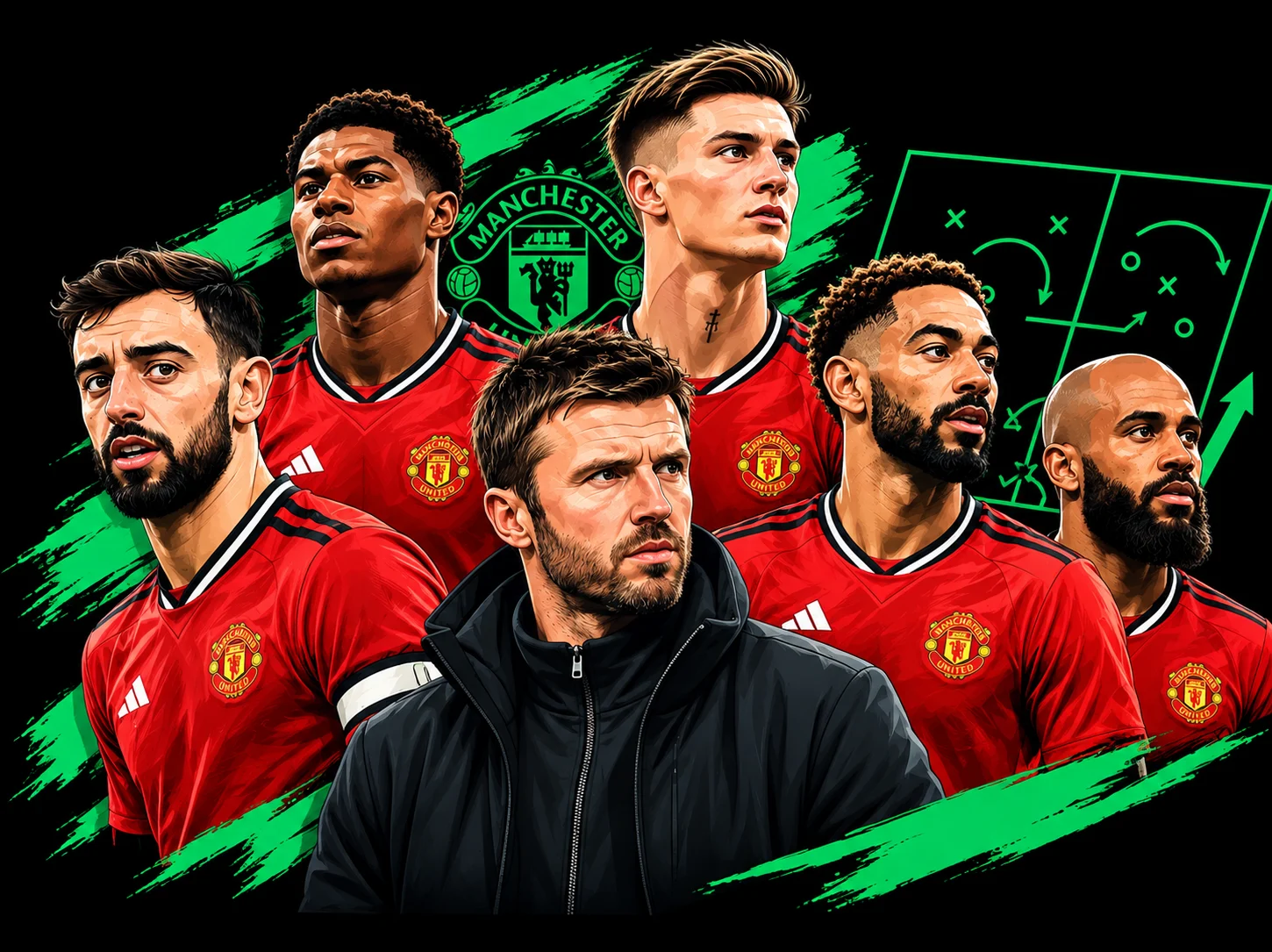
Man United Have the Fixtures to Win the League. Carrick and Bruno Fernandes Will Stop Them

In This Article
- Carrick's Record Was Better Than It Looked
- Why United Were So Good Against Better Teams
- The Problem Is What Happens When There Is No Space
- Bruno Fernandes Is the Actual Problem
- Last Season Showed Both Sides of the Problem
- Šeško Offers a Clue to the Solution
- The New Season Will Test United Differently
- The Squad Is Deeper. The Job Is to Use It Correctly.
- United Cannot Win the League by Waiting for Teams to Attack
- Carrick's Refusal to Make the Hard Call
- What Preseason Actually Told Us
- The Fixtures Are Not the Problem. The Two Men Running the Attack Are.
Manchester United’s preseason has reopened a familiar debate. Are they good enough to challenge for the Premier League title. After six games, the squad says yes. The schedule says yes too. The two men most responsible for turning results into a trophy say otherwise.
United have more attacking quality than a year ago. They have more depth. They added real quality in midfield. On paper, this is the strongest group Michael Carrick has managed at the club, and the fixture list gives them a real head start on the chasing pack.
None of that solves the actual problem. United will not win the league this season, and the reason is not the calendar. It is Michael Carrick’s unwillingness to change a setup built around a player who cannot consistently create chances against a low block, and it is Bruno Fernandes himself, whose game has a hole in it that has never closed at any level he has played. Carrick has the fixtures to win the title and is choosing not to fix the one thing standing in the way. That is a management failure, not bad luck.
Carrick’s Record Was Better Than It Looked
Carrick took over Manchester United in January with the club needing a major turnaround. He delivered one. United won 12 of his 17 Premier League matches, drew three, and lost two. They finished third and returned to the Champions League.
The results against major opponents stand out most. Manchester City were beaten 2-0. Arsenal were beaten 3-2 at the Emirates. Aston Villa lost 3-1. Chelsea were beaten 1-0. Liverpool were beaten 3-2. Brighton were beaten 3-0 on the final day.
This was not a manager struggling to compete with the best teams. It was close to the opposite. Carrick found a way to make United dangerous whenever the opposition gave them something to attack, and there is a clear tactical reason why.
Why United Were So Good Against Better Teams
Look at the players Carrick had available in attack. Bruno Fernandes. Matheus Cunha. Bryan Mbeumo. Amad. Benjamin Šeško. Marcus Rashford is also back in the picture this season. These are players built to attack space, and that distinction matters more than it sounds.
When United play a team that wants to dominate possession, they do not need to break down a settled defense first. They can let the opposition come forward. That creates space behind the midfield and behind the full-backs. Mbeumo, Cunha, Amad, or Rashford can receive the ball and immediately attack that space. Fernandes finds the pass. United transition quickly. A team that had 65 percent possession can suddenly find itself defending a three-on-three in its own half.
This resembles a principle Real Madrid used during their Champions League run under Zinedine Zidane. Madrid did not need to dominate every opponent territorially. Ronaldo and Bale attacked space. Benzema connected the attack. Isco carried the ball through midfield. Carrick’s United are not that Real Madrid team, but the underlying principle is the same one that made those sides so hard to defend. Give elite attackers space and they become significantly harder to stop. That is exactly what United found against several stronger sides last season.
The Problem Is What Happens When There Is No Space
Now change the opponent. United travel to a team sitting sixteenth. That team has no interest in controlling possession or pushing both full-backs forward. They put numbers behind the ball. They shrink the space between the lines. They ask United to break them down instead.
The advantage flips. The space Mbeumo wants to attack disappears. The space Cunha wants to run into disappears. The space Rashford wants to exploit disappears. The opponent refuses to give United the game that suits its best attacking qualities. This is where the deeper issue shows up, and it has a name.
Bruno Fernandes Is the Actual Problem
Bruno Fernandes puts up chance creation numbers that look elite on a stat sheet. Against a low block, the numbers stop translating into anything real. His best quality is the forward thread through a gap that a team leaves open when it commits players forward. Take that gap away and his passing becomes short, sideways, and safe. A team that sits deep and compact removes the exact space Fernandes needs to do his best work, and United currently have no reliable second way to break a defense down.
This is not a new pattern. It has followed Fernandes through his entire career with Portugal. At Euro 2020, Jose Mourinho described him as a flop after two anonymous group games, saying plainly that Fernandes simply was not showing up. Commentators at the time noted he looked like a shadow of his Old Trafford self, barely visible across matches where Portugal needed him to unlock organized defenses rather than exploit chaos. That pattern has repeated across tournament after tournament. Whenever Portugal face a side that sits in and defends with discipline, the player who dominates the Premier League against a stretched opponent goes quiet.
The connection is not a coincidence. International football is mostly low block football. Most nations set up to frustrate Portugal rather than trade chances with them, which is precisely the game state where Fernandes struggles at club level too. A player whose influence depends on space being handed to him will always look ordinary once that space is taken away, whether the shirt says Portugal or Manchester United. Judged on that standard, Fernandes plays like a mid-table talent rather than the number ten of a genuine title team.
United have spent several seasons building attacking structure around him anyway. He remains captain. He remains first name on the team sheet. Carrick inherited that setup in January and kept it in place through a run of form good enough to silence questions about it. The questions return the moment fixtures get tighter, because the underlying skill gap against a low block has not gone anywhere.
This is where the problem stops being about Fernandes alone and becomes about Carrick. A manager’s job is to see a limitation clearly and build around it or remove it. Carrick has had a full preseason and a favorable run of fixtures to make that call, and by every visible sign he has chosen to protect Fernandes’s role instead. Keeping the captain as the first-choice creator against every kind of opponent is not loyalty. It is a tactical decision, and it is the wrong one for a team with genuine title ambitions.
Last Season Showed Both Sides of the Problem
Carrick’s 17-game record included plenty of proof that United could beat strong teams. It also included games where United had to work much harder against opponents determined to make the match ugly. West Ham ended 1-1. Everton were beaten only 1-0. Crystal Palace were beaten 2-1. Brentford were beaten 2-1. Nottingham Forest were beaten 3-2. Leeds beat United 2-1. Sunderland held United to 0-0. Newcastle beat them 2-1.
United did not struggle in every one of these games, but many of them required a different tactical solution. There was less transition space and fewer chances to release the forwards in behind. United had to create chances against a compact structure, and that is exactly where the margins got tighter.
Šeško Offers a Clue to the Solution
Benjamin Šeško’s performance against Everton is worth a closer look. United were not playing an open game. Everton were not offering space. It was a difficult match. Šeško came off the bench and scored the winner in the 71st minute, finishing a quick move built by Cunha and Mbeumo.
That points to the value of a striker who can change the shape of a tight game. When matches stay compact, United need players who can produce something from limited chances. Šeško gives Carrick a physical option who can attack crosses, occupy centre-backs, and finish the few clear chances a tight game usually offers.
The New Season Will Test United Differently
Last season, opponents had little time to prepare for Carrick’s version of United. He arrived in January, changed the system, and moved United into a back four that unlocked several players. Teams were reacting to United, not planning for them.
That advantage is gone. Every club has had a full summer to study this team. They know United want to transition quickly. They know Mbeumo wants space, Cunha wants to carry the ball, and Rashford wants to run in behind. They know Fernandes will look for the killer pass. So why would a team sitting fourteenth choose to give United an open game? They will sit deeper instead, protect the centre, and force United to prove they can create chances without relying on transition.
The Squad Is Deeper. The Job Is to Use It Correctly.
The encouraging part is that Carrick now has more tools than he did in January. Youri Tielemans adds a passer who can control possession against a compact midfield. Andrey Santos adds physical presence in the middle. Šeško changes the attacking profile. Mbeumo remains an elite transition threat. Cunha can carry the ball and operate between the lines. Fernandes remains the player who finds a solution when the obvious pass isn’t there.
Having the tools is not the same as using them well. That responsibility sits with Carrick.
United Cannot Win the League by Waiting for Teams to Attack
United can destroy a team that attacks them without caution. But Arsenal will not do that every week. Liverpool will not do that every week. City will not do that every week. Teams near the bottom of the table certainly will not.
The Premier League is not won by collecting a handful of spectacular wins over elite opponents. It is won by accumulating points relentlessly. Manchester United finished third last season with 71 points. Arsenal finished first with 85. Manchester City finished second with 78. United need another 14 points to match last season’s title-winning total, and those points will not mostly come from beating the biggest clubs. They will come from Everton away, West Ham away, Sunderland away, Leeds at home. Games where the opponent’s plan is to make the match difficult rather than entertaining.
Carrick’s Refusal to Make the Hard Call
Carrick does not need to abandon the transition game. It remains one of United’s biggest strengths. The decision he is avoiding is what to do about the player currently built into every attacking sequence regardless of the opponent.
Tielemans offers a genuine alternative in games that need patience rather than transition. He can retain the ball under pressure and find a pass through a compact block without needing the gaps Fernandes relies on. Using him as the primary creator against low block sides, rather than as a rotation option around Fernandes, would give United a second way to attack that does not collapse the moment space disappears. That means leaving out the captain in specific matchups. Nothing in Carrick’s approach so far suggests he is prepared to do that.
This is the part that turns a squad limitation into a manager’s failure. Every top coach eventually has to make an unpopular call on a senior player for the good of the team. Carrick has the fixtures, the depth, and the alternative sitting on his bench, and he is still building the team the same way he did in January. Better movement between the lines and more overloads from the full-backs will help at the margins. They will not fix a central creative outlet that depends on space he will not get against two thirds of the Premier League table this season. The team cannot simply wait for the opponent to make a mistake. It has to force the mistake, and forcing it starts with a decision Carrick has not shown any sign of making.
What Preseason Actually Told Us
United’s six preseason matches gave another reason to ask the question properly. They beat Wrexham 5-0 and Atlético Madrid 2-1, drew with PSG and Leeds, and lost 4-2 to AC Milan. The results themselves mean little in August. The patterns matter more.
United looked dangerous whenever they could attack space. They also showed moments of losing control after taking the lead. Against Milan, they led twice and still lost 4-2. Against Leeds, they took the lead but couldn’t hold on for the win. Preseason has not proven Carrick can’t manage a lead or a tight game. It has simply confirmed United still have another level to reach before the title conversation is serious.
The Fixtures Are Not the Problem. The Two Men Running the Attack Are.
Judging Carrick harshly off six preseason games alone would be unfair. His record last season earns him real credit. He won 12 of 17 Premier League matches, beat several of the best teams in England, and turned a struggling side into a Champions League club again. That record is exactly why this season’s failure will sit on him rather than on the fixture list.
Teams now know exactly what United want to do, and most will refuse to give it to them. They will sit deeper, defend narrower, and dare Fernandes to unlock them without the space he depends on. History with Portugal says he won’t, and nothing about his game has changed enough to expect a different outcome at club level. Carrick has seen this pattern for a full season already and has not changed course.
Manchester United may be one of the most dangerous counter-attacking teams in the league right now. Give them space and they have the players to punish it. But the title is never won by playing only teams that attack. It is won by beating the teams that sit in and refuse to, and that is precisely where Fernandes has always struggled and where Carrick has refused to plan around it. United have the fixtures to win the league this season. Carrick and Fernandes, not the calendar, are why they won’t.
UA
Also known as I'm Unimke Abana, also known as Binoculars, bringing you the world of football with clear vision.