How Missing Messi and Ronaldo Left Manchester City Dominant on the Pitch and Defenceless Everywhere Else
In This Article
Manchester City built one of the most dominant football machines in the history of the English game.
Six Premier League titles in eleven years. A treble. A squad assembled with surgical precision under the most tactically sophisticated manager of his generation. By every measurable sporting standard, they succeeded.
And yet something went wrong. Not on the pitch. Something deeper.
This past Premier League season did not just expose squad vulnerabilities or a post-Guardiola dip in form. It exposed how fragile dominance becomes when it is built entirely on sporting merit and commercial investment, with no corresponding foundation in global emotional loyalty.
The root of that vulnerability traces back to two decisions City made years ago. Two moments where the club could have permanently changed their place in world football. Two opportunities they let pass.
Signing neither Lionel Messi nor Cristiano Ronaldo was not just a missed transfer. It was a strategic miscalculation that is now shaping how the Premier League ecosystem responds to City’s dominance.
The League Is Not Purely a Sporting Competition
Elite football at the highest level operates as a global entertainment economy. Sporting competition is real. The results matter. The tables are honest.
The institutional framework surrounding those results is a separate matter.
No major football league genuinely benefits from the perception that one club has made competition structurally irrelevant. Competitive tension is the commercial product. Hope is the product. The belief that any given season could produce a different story is what keeps global audiences emotionally invested across multiple fan bases.
When that tension disappears, broadcasters get nervous. Sponsors get nervous. Executives start having conversations about what needs to change.
That is not a conspiracy theory. It is how entertainment economies protect themselves.
The Premier League did not need a coordinated backroom effort to tilt outcomes against Manchester City. The institutional incentives were already pointing in that direction. To many supporters(City and others like me), officiating patterns across the season appeared to reflect those incentives. Crucial decisions in close matches repeatedly broke against City’s league campaign and in favour of Arsenal, with a significantly larger global emotional audience. Arsenal was the primary beneficiary.
The cumulative effect across a full season functioned like a structural rebalancing. Whether each individual decision was conscious or not is a separate debate. The pattern itself is observable.
And the reason City had no protection against that pattern comes back to the same problem: they never built the kind of global emotional loyalty that makes institutions politically difficult to isolate.
What Emotional Loyalty Actually Does for a Football Club
Manchester United spent the better part of a decade producing mediocre football. They cycled through managers. They wasted transfer budgets. They finished outside the top four multiple times.
Their global fanbase barely flinched.
Shirt sales remained strong. Social media engagement remained enormous. Global media continued treating United as a story worth covering regardless of results. That loyalty was inherited across generations. It was built during the Ferguson era through sustained winning and through iconic players who created emotional imprinting in millions of children worldwide.
Emotional loyalty of that scale does not erode through bad seasons. It survives decades of failure because the attachment was formed early and formed around figures who became larger than the club itself.
Arsenal carry a similar kind of loyalty. Wenger’s Arsenal teams created supporters across Africa, Asia, and South America who have remained attached through two decades without a title. Those fans were not watching Arsenal because they were winning. They were watching because something about that club, those players, that identity lodged permanently in their memory at a formative age.
Manchester City have trophies. They do not yet have that.
Why Missing Messi Changed City’s Trajectory
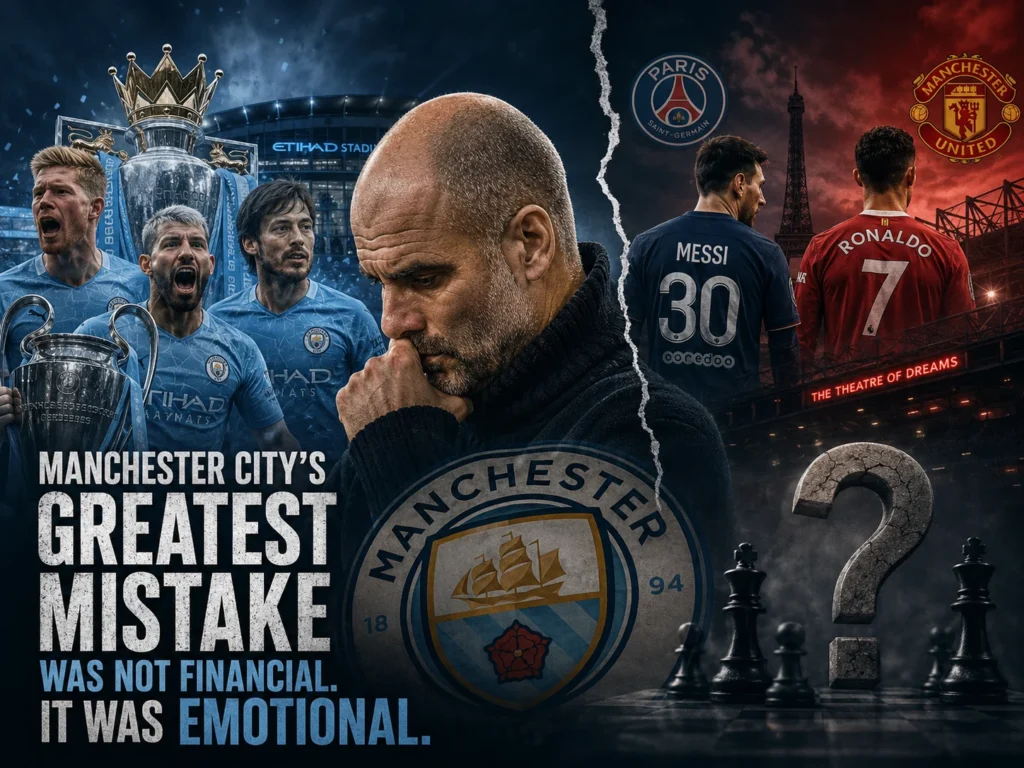
When Messi left Barcelona in the summer of 2021, Manchester City had the clearest opportunity in modern football to solve their emotional loyalty problem in a single transfer.
Guardiola was already at the club. The philosophical connection between Guardiola and Messi was understood globally. Millions of football supporters who had followed Barcelona through the Guardiola era already had a psychological association between those two figures. City’s positional identity already mirrored what Messi had thrived in at Camp Nou.
Signing Messi would not just have added the world’s most decorated player to the squad. It would have transferred an enormous portion of his global fan ecosystem into City’s institutional identity.
Children who grew up watching Messi would have started watching City. Casual supporters across South America, Africa, and Asia who had no previous connection to English football would have had a reason to follow Premier League matches. That attention compounds over time. It becomes the next generation of shirt buyers, subscribers, and emotionally invested supporters.
A Manchester City built around Messi at his final peak would have felt different to the world. It would have felt like a destination, not a machine. The club would have accumulated the kind of emotional mythology that makes institutions untouchable within football ecosystems.
Instead, Messi went to Paris and then to Miami. City continued winning. The emotional gap remained.
The Ronaldo Decision Made the Problem Worse
City were given a second chance almost immediately.
When Ronaldo agitated for a move away from Juventus that same summer, City were involved in negotiations. The move collapsed. Ronaldo returned to Manchester United.
What followed is instructive.
United’s football that season was inconsistent and ultimately disappointing. By most sporting measures, the Ronaldo reunion failed. And yet the global engagement around Manchester United during that period was extraordinary. Shirt sales broke records. Social media numbers surged. Every United match carried a level of global attention that bore no relationship to where they actually were in the table.
That is the Ronaldo effect. It has nothing to do with results and everything to do with the gravitational pull iconic figures create around institutions. Ronaldo did not make United better. He made United matter again to audiences who had been drifting away.
City allowed that to happen. They let United recapture emotional relevance at the exact moment City were trying to cement their own era.
The symmetry of those two decisions, missing Messi and then watching Ronaldo revive a rival, captures precisely how City’s strategic thinking failed to account for the emotional dimension of modern football.
Guardiola’s Blind Spot
None of this diminishes what Guardiola built at Manchester City. The football has been extraordinary. The tactical evolution across his tenure represents some of the most sophisticated work any manager has produced in the Premier League era.
Guardiola believed that sustained excellence would eventually make City’s position unassailable. From a sporting perspective, he was largely right.
The blind spot was believing that football institutions are ultimately judged on sporting terms alone.
The biggest clubs in football history are not simply the clubs that won the most. They are the clubs that captured the world’s emotional imagination at scale, usually through players who became cultural figures beyond the sport itself. Ferguson’s United had Cantona, Beckham, Keane, Scholes, Giggs, and Ronaldo. Each one extended United’s emotional reach into a different corner of the world.
City had Silva, Kompany, De Bruyne, and Aguero. Elite players. Beloved within City’s own supporter base. None of them transferred emotional loyalty at global scale the way Messi or Ronaldo would have.
The result is a club that has dominated English football for a decade and still finds itself politically exposed within the ecosystem that surrounds it. Dominant on results. Vulnerable everywhere else.
That vulnerability did not appear this season. It was decided years earlier, in the summers when two phone calls did not end the way they should have.
Sustained dominance alone rarely creates new global supporters at the same rate as iconic football figures. Younger audiences often attach themselves first to personalities, then to institutions. Manchester City became respected worldwide. They did not become emotionally inherited worldwide.
UA
Also known as I'm Unimke Abana, also known as Binoculars, bringing you the world of football with clear vision.