
Neymar vs Rooney: A Data-Driven Career Comparison Using the ZFP System
In This Article
Football debates often collapse into personal preference. One group points to flair and creativity. Another values consistency, trophies, and longevity. The debate comparing Neymar and Wayne Rooney has followed this pattern for years, producing heat but rarely any light.
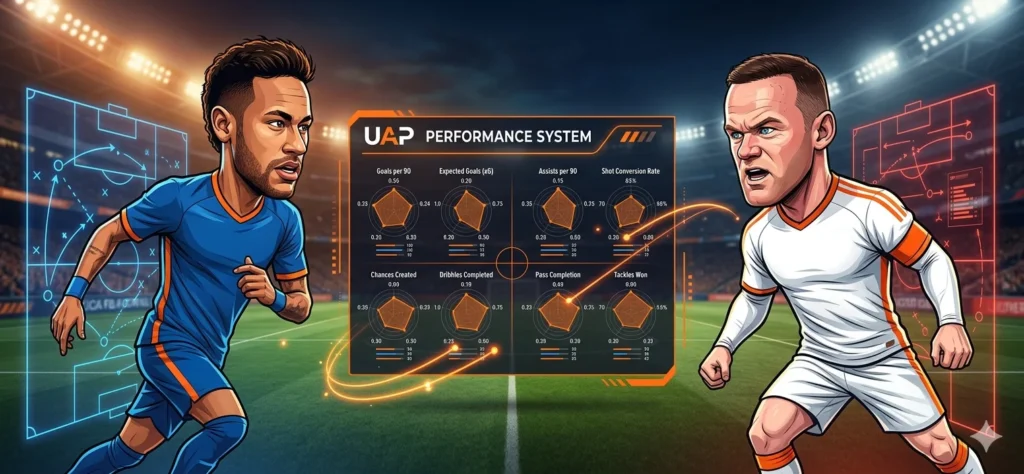
Rather than adding to the noise, I ran both careers through a structured analytical model of my own design. The goal: evaluate measurable output in a way that accounts for where each player competed, how they were individually recognised, and what they achieved as leaders.
The result is the ZFP System, short for Zonal Football Performance System. It is built around four pillars: weighted goal output, weighted assist output, individual awards, and captain/leadership trophies. Each is scored against verified career data.
What the numbers reveal is closer than almost anyone expects.
The Zonal Football Performance System: How It Works
The ZFP System was built on one core principle: not all competitions carry the same weight, and a performance model that ignores competitive context will always produce a distorted picture.
The system evaluates players using position-specific pillars. For attacking players, those pillars are goals, assists, key passes, and chances created, alongside individual awards and leadership trophies. Every metric is weighted according to the league in which it was produced.
The league multiplier is not assigned arbitrarily. It is determined by counting the number of unique title winners in a given league over the last 10 to 15 seasons. The more clubs that have won the title, the more competitive the league, and the higher the multiplier applied to every goal, assist, and award earned there.
The multiplier table is as follows:
5 or more unique title winners: 2.0 points per goal or assist. These are the most open and competitive leagues in the world. The Premier League, MLS, Serie A in its competitive era, and the Turkish Süper Lig all sit here.
3 to 4 unique title winners: 1.5 points per goal or assist. Leagues where the title changes hands but within a small group of dominant clubs. La Liga and the Bundesliga fall into this bracket.
2 unique title winners: 1.3 points per goal or assist. Leagues where two clubs share dominance almost entirely across the sample window.
1 unique title winner: 1.25 points per goal or assist. Leagues controlled by a single club where the title race is rarely competitive.
Applying this to the leagues relevant to this comparison produces the following. The Premier League scores 2.0, with Manchester United, Manchester City, Chelsea, Arsenal, Leicester City, and Liverpool all winning the title across the last 15 seasons. La Liga scores 1.5, with Real Madrid, Barcelona, and Atletico Madrid as its three title winners in that window. Ligue 1 scores 1.5, with PSG, Monaco, and Lille all having lifted the trophy in the relevant period. The Brazilian Serie A scores 2.0, reflecting genuine title diversity across Flamengo, Palmeiras, Corinthians, Atletico Mineiro, Fluminense, and Cruzeiro. MLS scores 2.0 given its consistent rotation of champions.
These multipliers apply to all competitions played while a player is based in that country, including European matches and domestic cups.
For individual awards, the ZFP System scores as follows:
Player of the Month: 2 points, multiplied by the league multiplier of the country where it was won. Player of the Season: 3 points, multiplied by the league multiplier. Best Forward or position-specific award: 5 points, multiplied by the league multiplier. Top 3 Ballon d’Or finish: 10 points, no multiplier applied. Top 5 Ballon d’Or finish: 5 points, no multiplier applied. Top 10 Ballon d’Or finish: 3 points, no multiplier applied. Finals MVP or continental tournament MVP: 10 points, no multiplier applied.
For leadership, captaining a side to a trophy earns 10 points per trophy won. Vice-captaincy earns 5 points per trophy won.
The ZFP System compares players only within the same position. A striker is evaluated against strikers. A centre-back against centre-backs. Cross-position comparisons are not valid under this framework. Neymar and Rooney both operated as forwards and attacking players across their careers, making this a legitimate comparison under the system.
Career Context
Wayne Rooney spent the bulk of his career at Manchester United, where he became the club’s all-time record scorer with 253 goals. He debuted at Everton at 16, returned there briefly toward the end of his career, and closed out his playing days at D.C. United in MLS.
Neymar began at Santos in Brazil, moved to FC Barcelona in 2013 where he formed the famous MSN trio with Messi and Suárez, then joined Paris Saint-Germain in 2017 for a then-world record fee of 222 million euros. Injuries significantly disrupted his years in Paris and have continued to affect his career.
Both players built decorated careers. The ZFP System exists precisely to evaluate those careers on equal terms, regardless of which league each player called home.
Pillar One: Goal Output
All goals across all competitions, weighted by the multiplier of the country where the club is based.
Neymar
- Santos: 136 goals x 2.0 = 272.0
- Barcelona: 105 goals x 1.5 = 157.5
- PSG: 118 goals x 1.5 = 177.0
- Weighted goal total: 606.5
Rooney
- Everton: 28 goals x 2.0 = 56.0
- Manchester United: 253 goals x 2.0 = 506.0
- D.C. United: 25 goals x 2.0 = 50.0
- Weighted goal total: 612.0
Rooney leads this pillar by 5.5 points. The margin is narrow enough to be almost negligible, and it is driven almost entirely by the volume Rooney accumulated at Manchester United across 13 seasons in one of the world’s most competitive leagues. Neymar’s Santos output is substantial in weighted terms, reflecting the genuine competitiveness of Brazilian football under the ZFP multiplier.
Pillar Two: Assist Output
All assists across all competitions, weighted by the multiplier of the country of the club.
Neymar
- Santos: 65 assists x 2.0 = 130.0
- Barcelona: 76 assists x 1.5 = 114.0
- PSG: 79 assists x 1.5 = 118.5
- Weighted assist total: 362.5
Rooney
- Everton: 4 assists x 2.0 = 8.0
- Manchester United: 146 assists x 2.0 = 292.0
- D.C. United: 14 assists x 2.0 = 28.0
- Weighted assist total: 328.0
Neymar leads this pillar by 34.5 points. He operates as a creator and dribbler as much as a finisher, and that dual role produces assist numbers that Rooney, who spent his peak years as a central forward and later a deeper midfielder, simply could not match. The creative pillar belongs to Neymar without serious contest.
Pillar Three: Individual Recognition
Neymar
- Campeonato Brasileiro Player of the Year 2011 and 2012: 2 x (3 x 2.0) = 12.0
- Ligue 1 Player of the Year 2017-18: 3 x 1.5 = 4.5
- Ligue 1 Player of the Month (confirmed x1): 2 x 1.5 = 3.0
- Ballon d’Or top 3, 3rd place in 2015 and 2017: 2 x 10 = 20.0
- Ballon d’Or top 10, 10th place in 2011: 1 x 3 = 3.0
- Individual award total: 42.5
Rooney
- PFA Players’ Player of the Year 2009-10: 3 x 2.0 = 6.0
- FWA Footballer of the Year 2009-10: 3 x 2.0 = 6.0
- Premier League Player of the Month x5: 5 x (2 x 2.0) = 20.0
- Ballon d’Or top 10, 5th place in 2011: 1 x 3 = 3.0
- FIFA Club World Cup Final MVP 2008: 10.0
- Individual award total: 45.0
Rooney leads this pillar by 2.5 points, the smallest margin across any category in this comparison. Neymar’s two Ballon d’Or top 3 finishes are worth 20 points alone and represent a level of global recognition Rooney never reached. Finishing in the world’s top three players in 2015 and 2017, during an era entirely defined by Messi and Ronaldo, is exceptional by any measure. Rooney’s edge comes from the FIFA Club World Cup Final MVP, five Premier League Player of the Month wins at the full 2.0 multiplier, and two separate Player of the Season awards earned in England’s most competitive environment.
Pillar Four: Leadership Trophies
Neymar
- 2016 Rio Olympics gold medal as captain of Brazil U23: 10.0
- Leadership trophy total: 10
Rooney
- FA Cup 2016 as Manchester United captain: 10.0
- League Cup 2017 as Manchester United captain: 10.0
- UEFA Europa League 2017 as Manchester United captain: 10.0
- Community Shield 2016 as Manchester United captain: 10.0
- Leadership trophy total: 40
Rooney leads this pillar by 30 points, the largest single gap in the entire comparison. He captained Manchester United to four trophies spanning domestic cups and European competition. Neymar captained Brazil’s U23 side to gold at the 2016 Rio Olympics, scoring the winning penalty in the shootout against Germany in front of a home crowd. It remains one of the defining moments of his career. But this pillar is where the overall verdict is decided.
Grand Total
| Category | Neymar | Rooney |
|---|---|---|
| Weighted Goals | 606.5 | 612.0 |
| Weighted Assists | 362.5 | 328.0 |
| Individual Awards | 42.5 | 45.0 |
| Leadership Trophies | 10.0 | 40.0 |
| Grand Total | 1,021.5 | 1,025.0 |
What the Numbers Mean
The overall margin is 3.5 points across more than a thousand scored. That is not a verdict. It is a draw with a tiebreaker.
Rooney leads in three of the four pillars. He edges Neymar on weighted goals by 5.5 points, on individual awards by 2.5 points, and dominates the leadership pillar by 30 points. Neymar’s only pillar win is weighted assists, where he leads by 34.5 points, reflecting how central creativity and chance creation were to his game.
The real story the ZFP System tells is one of balance. Rooney’s leads across goals, awards, and leadership are real, but none of them are commanding. Neymar’s assist advantage is the largest single-pillar margin in the entire comparison, and it is the reason the overall gap stays under 4 points despite Rooney winning three of the four categories.
Remove the leadership pillar entirely and Rooney still leads, but only by 3 points across goals and individual awards combined, while Neymar leads assists by 34.5. The two careers are that close across purely on-pitch metrics.
What ultimately separates them in the final score is captaincy. Rooney’s 30-point leadership advantage, earned from four trophies lifted as Manchester United captain, is the cushion that makes his overall lead stick.
Longevity and the Availability Problem
One factor that does not appear in any scoring pillar but shapes the context of everything above: durability.
Rooney played over 550 games for Manchester United across 13 seasons. He was a consistent presence at the highest level for well over a decade, adapting his role from explosive teenage striker to creative forward to deep-lying playmaker as the years passed.
Neymar missed 119 matches for PSG alone. He managed 30 or more league appearances in a single PSG season only once. The injuries were not isolated incidents. They became a career-long pattern that directly suppressed his output across every pillar of this analysis.
The ZFP System scores what each player actually produced. Had Neymar stayed fit across his PSG years, the gap between these two careers would very likely have opened in his favour.
Verdict
By the Zonal Football Performance System, Wayne Rooney holds the narrowest possible overall lead: 1,025.0 to 1,021.5.
Neymar is one of the most technically gifted attackers the sport has ever produced. The ZFP System confirms that his on-pitch contribution across goals, assists, and global recognition was marginally superior to Rooney’s across their careers. Rooney’s overall lead exists because of four trophies lifted as captain of Manchester United, and on that measure, he deserves it.
These are not two players separated by a clear gap in quality. They are two players separated by 3.5 points across a thousand-point model, with different strengths in different areas. The ZFP System does not flatten that complexity. It maps it precisely.
A Question for Zonalfootball Readers
The ZFP System produces a result, but football conversations rarely end with a spreadsheet.
The data shows these two careers are almost identical in overall value. But careers are also more than numbers.
If you were building a team around one of these players in their absolute prime, would you take Neymar’s creativity and flair, or Rooney’s relentless productivity and leadership?
Drop your answer in the comments. The debate is far from settled.
UA
Also known as I'm Unimke Abana, also known as Binoculars, bringing you the world of football with clear vision.