The Premier League's Real Long-Term Problem Has Nothing to Do With Manchester City
In This Article
When PGMOL executives talk about “keeping the Premier League attractive,” most people read it as a sporting conversation.
It is a marketing conversation.
Football stopped being just football a long time ago. Modern elite football is audience retention. It is emotional loyalty, subscription economics, global branding, and generational influence. All of it compressed into ninety minutes, twice a week, across forty weeks of the year.
And the Premier League’s biggest long-term threat is not Manchester City winning too many titles. That is the surface argument.
The deeper problem is this: the next generation of global football fans may be forming their earliest emotional attachments in Spain.
Why Childhood Is the Only Market That Matters
Most football fans do not choose their clubs through logic.
They inherit emotional attachments. Usually in childhood. Usually through a single player or a single moment that lodges itself somewhere permanent.
I became a Manchester United fan because of the 1999 Champions League final. Ruud van Nistelrooy made that attachment irreversible. Real Madrid became my second club because of Fernando Redondo. AC Milan became my third because of Rui Costa.
Then Wayne Rooney arrived at United, and I was fully anchored.
I also loved Lazio, Fiorentina, and Parma. Not because they were winning leagues. Because Verón, Batistuta, and Crespo played there. Elite Argentine footballers carried my attention everywhere they went, and that thread traced back to Maradona.
I barely watched Maradona play live. CRTV used to air his documentaries almost every week when I was young, and I watched them repeatedly. Those broadcasts built an emotional architecture around a player I never properly saw in his prime.
That is the mechanism. Fans are not built only through trophies. They are built through emotional imprinting, and the process begins far earlier than most leagues acknowledge.
La Liga Has the Players Who Create That Imprinting Right Now
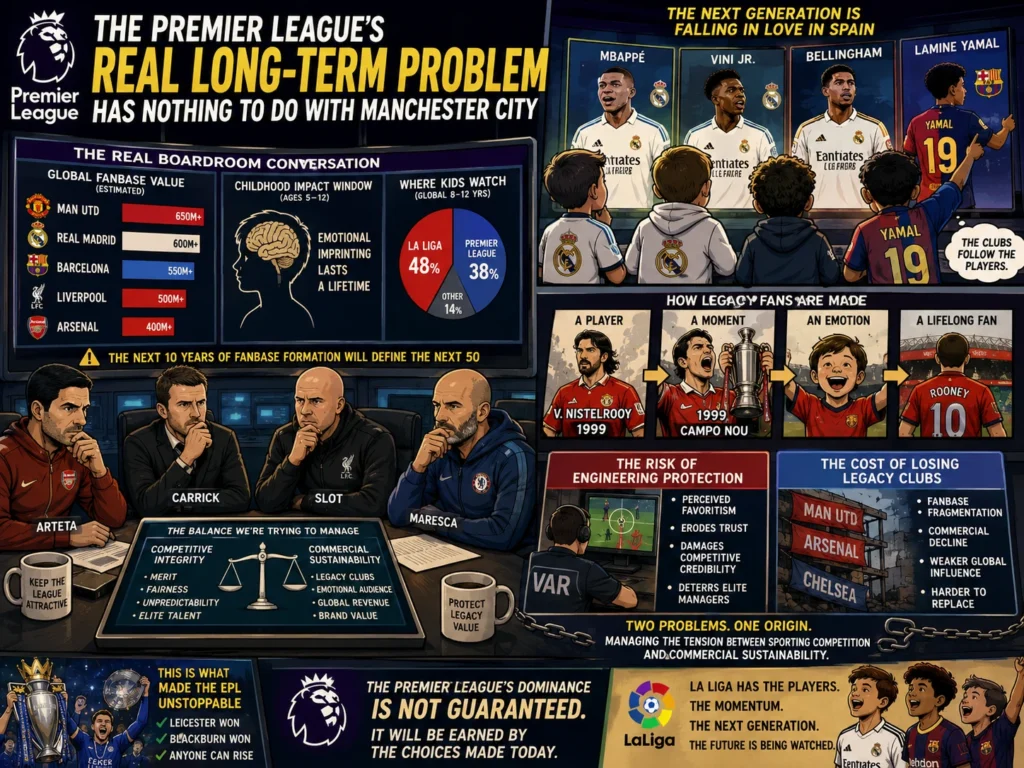
Today’s children are growing up watching Mbappé, Vinícius Jr., Bellingham, and Lamine Yamal.
Four of the most culturally prominent footballers on the planet. All of them currently playing in Spain.
That is not a coincidence. Real Madrid have been assembling a generational squad with extraordinary commercial intelligence. Barcelona are rebuilding around a 17-year-old who already carries the visual language of a future global icon.
Children who are eight or ten years old right now are forming their first football loyalties in this environment. They are not necessarily choosing Real Madrid over Arsenal. They are choosing Mbappé and Vinícius Jr. The clubs follow the players.
When those children become teenagers with purchasing power, and eventually adults with children of their own, the emotional gravity they carry will have been set during this period.
The Premier League understands this dynamic. Which is why legacy fanbases matter commercially far beyond their current trophy counts.
The Commercial Logic Behind Protecting Legacy Clubs
Manchester United have won one trophy in the last seven years. Arsenal have not won a title in over two decades. Chelsea have spent obscene amounts of money to produce inconsistent football.
And yet those three clubs still command some of the largest global emotional audiences in the sport.
That loyalty was built during periods of sustained dominance and iconic players. It has survived poor ownership, managerial chaos, and years of underperformance.
That durability is what makes legacy fanbases so commercially valuable. Emotional attachments formed in childhood survive decades of failure. A child who decided to support Manchester United in 2008 because of Cristiano Ronaldo is still a United supporter in 2025, even through the Moyes years and the Ole years and everything after.
The Premier League ecosystem benefits from clubs that hold large emotional audiences. United, Arsenal, and Chelsea in decline are still commercially significant to the league. United, Arsenal, and Chelsea permanently irrelevant would be a structural problem.
This is why the league’s concern about legacy clubs has a logic that extends beyond sentiment.
The Risk of Engineering That Protection
There is a version of this that goes wrong.
If the Premier League is perceived to be structurally protecting certain clubs through officiating patterns, regulatory decisions, or institutional favoritism, it begins to corrode the thing that made the league compelling in the first place.
The Premier League became the world’s dominant league largely because of genuine competitive unpredictability. Leicester won the title. Blackburn won the title. Every club felt capable of rising through merit, investment, and elite management.
That perception matters to managers just as much as it matters to fans.
Top managers choose leagues and environments where sporting outcomes are determined by quality. If the Premier League develops a reputation where certain clubs are protected institutions rather than sporting competitors, some elite coaches will eventually factor that into their decisions. Not all of them. But some.
And if the league loses the ability to attract the full range of elite managerial talent, it loses a key part of what separates it from rival leagues.
The irony is considerable. Protecting legacy clubs to maintain commercial appeal could damage the competitive environment that gave those clubs their appeal in the first place.
Two Problems With One Origin
The generational fanbase issue and the competitive integrity issue look like separate conversations. They share a single root cause.
The Premier League is trying to manage the tension between sporting competition and commercial sustainability. Every major league faces some version of this. The Premier League faces it at the highest level of global scrutiny.
Getting that balance wrong in either direction carries consequences.
Lean too far toward protecting legacy clubs and you create an environment where genuine competition feels staged. Lean too far the other way and you risk those legacy fanbases slowly fragmenting, with nothing to replace the commercial foundation they represent.
La Liga is not sitting still while this plays out. They have the players right now. They have the cultural momentum with young audiences. They do not need the Premier League to fail. They just need children to keep deciding that their first football love lives in Madrid or Barcelona.
The next ten years of global fanbase formation will tell us whether the Premier League’s current dominance is structural or generational.
My suspicion is it is more generational than the league’s executives would like to admit.
UA
Also known as I'm Unimke Abana, also known as Binoculars, bringing you the world of football with clear vision.