
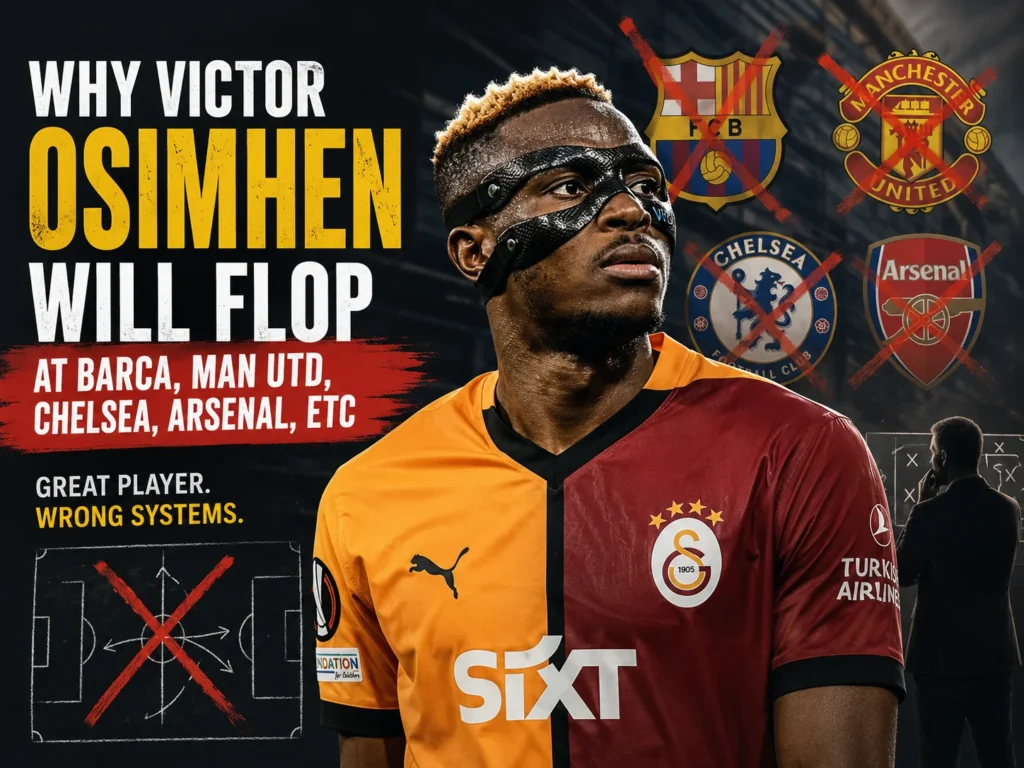
Why Victor Osimhen Will Flop at Elite European Clubs
In This Article
Victor Osimhen is a genuinely good footballer. His physicality is rare. His pressing is relentless. His finishing instinct under pressure is the kind of quality that cannot be manufactured through coaching or system design. When he attacks space, defenders make decisions they would not otherwise make. When the ball enters the penalty area, he is almost always its most dangerous destination.
None of that is in dispute.
What is in dispute is whether the clubs capable of buying him are actually capable of using him. And when you trace the evidence carefully, the answer is more uncomfortable than most of the transfer discourse around him acknowledges.
Osimhen does not simply need a good team. He needs a specific type of team. And the clubs currently linked with signing him are almost all built on a philosophy that makes that type of team structurally impossible.
The Distinction Modern Football Has Made Unavoidable
Not all strikers make the same demands on a system. Some are built to function as one productive piece inside a larger attacking machine. Goals are distributed across the squad. Wingers score. Midfielders arrive late and score. The striker contributes his share, but the attack has no single centre of gravity. The team itself is the identity.
Others require something different. The midfield looks for them first. The wingers deliver early because they know where the ball needs to go. The entire attack organises itself around a single focal point, and that focal point is the number nine.
This is not a clean binary. Real football sits messier than two tidy categories. But the direction of travel at elite level has been clear for over a decade. The clubs winning Champions Leagues are overwhelmingly built around distributed attacking load, multiple scoring threats, and deliberate resistance to dependence on any one player. That architectural choice is not accidental. It makes those clubs harder to defend, more resilient through individual dips in form, and less vulnerable to injury disruption.
Osimhen’s best football has consistently required the other type of environment. That tension is where the real conversation begins.
What Napoli Actually Built
Osimhen’s peak season did not happen because he suddenly became a different footballer in 2022-23. It happened because Napoli made a series of deliberate structural decisions that pointed their entire attack in one direction.
When he arrived in 2020, Napoli still distributed their attacking load across multiple contributors. Lorenzo Insigne was a primary creative and scoring outlet. Dries Mertens provided reliable finishing from deeper positions. Hirving Lozano offered threat from wide. In that environment, Osimhen scored 10 goals in a debut season disrupted by injury, then 18 goals the following season. Solid numbers. Insigne and Mertens each contributed 11 goals in that same campaign, confirming that Napoli remained a genuinely distributed attacking unit.
Then the squad changed fundamentally. Insigne left for Toronto. Mertens departed. Napoli rebuilt their attack with Osimhen as the undisputed focal point and brought in Kvaratskhelia as a wide creator whose primary function was to generate chaos and feed the striker. The attacking structure was not adjusted around Osimhen. It was rebuilt around him from the ground up.
The result was 31 goals across all competitions as Napoli won their first Serie A title in 33 years.
That season was extraordinary. It was also the product of an architectural decision that almost no elite European club is currently willing to replicate. And it is almost entirely the basis on which Osimhen’s market value has been constructed. A single season, inside a system designed exclusively around him, has become the reference point for his entire career valuation. That is the first structural problem with how this transfer conversation is being conducted.
The Andy Carroll Warning
Football has delivered this lesson repeatedly. Clubs continue to absorb the cost of ignoring it.
Andy Carroll was genuinely dominant at Newcastle United. The entire attack was built around his physicality and aerial ability, and he thrived because the service he needed arrived consistently. Liverpool paid 35 million pounds for him in 2011 and placed him inside a possession-based system where that service did not exist. His impact collapsed immediately. Not because his ability disappeared, but because the tactical environment that made him dangerous had been removed and not replaced.
Osimhen is a far more complete footballer than Carroll. The comparison is not about their respective quality. It is about the structural risk they share. A striker whose best football depends on a specific volume and type of service, arriving at a club that distributes that service across five different attackers, is a striker whose numbers will fall. The quality of the player does not override the logic of the system.
The Gyökeres Evidence, Live and Ongoing
The most current demonstration of this pattern is Viktor Gyökeres at Arsenal, and it is still unfolding.
At Sporting CP, Gyökeres was the offensive engine around which everything else was organised. In his final season at the club he scored 54 goals in 52 games across all competitions, won the Gerd Müller Trophy as Europe’s top scorer, and entered the summer transfer window as one of the most feared strikers on the continent.
Arsenal signed him and placed him inside a system where the attacking load is shared across Bukayo Saka, Gabriel Martinelli, Eberechi Eze, and midfield runners arriving from deep positions. The service is not directed at one player. The system has no single focal point by design.
Gyökeres has managed 11 Premier League goals from over 20 appearances in 2025-26. The rate is substantially below what he produced at Sporting. There have been goal droughts that would have been unthinkable at his previous club. Comparisons with what Harry Kane would have contributed in the same system have appeared in mainstream coverage.
Gyökeres is not failing. He is a talented player who will find his level inside a strong squad. But the contrast between his output in a system built around him and his output inside a distributed attack is exactly the pattern that matters here. Osimhen is a more extreme version of the same profile. The implication for any club considering signing him should be obvious.
The Luis Suárez Confirmation
The most compelling piece of evidence in this entire argument does not come from Osimhen’s career. It comes from the club Gyökeres left behind.
When Sporting needed a striker to replace him, they signed Luis Suárez. Not the former Barcelona and Liverpool forward. A Colombian forward who had spent most of his career in the lower divisions of Spanish football before a breakout season at Almería in the Spanish second tier, where he scored 31 goals and added 8 assists. One outstanding season. Largely unheralded outside Spain. Twenty-eight years old with no significant top-level European experience.
At Sporting, placed into the same system Gyökeres had just vacated, built entirely around its centre-forward, Suárez has scored 25 goals and provided 4 assists in 28 club appearances in 2025-26.
That is not a coincidence. That is the system at work.
It is the most honest possible statement about where the goals actually come from. The environment was built for a specific type of striker. Gyökeres thrived in it. A relatively unknown replacement was inserted and produced elite numbers almost immediately. The structure did not change. Only the player did.
This does not diminish what Osimhen has achieved. But it should fundamentally reshape how transfer fees attached to system-dependent production are evaluated. The goals belong partly to the striker. They belong significantly to the architecture around him.
Why Elite Clubs Cannot Give Him What He Needs
Manchester City, Arsenal, and Real Madrid have spent years constructing attacks that are deliberately resistant to dependence on any single player. At City, goals flow from multiple sources simultaneously across the front line and arriving midfielders. At Arsenal, Saka and Martinelli are primary threats entirely independent of whoever occupies the striker position. At Madrid, the attacking distribution spans the entire front line and beyond it.
These are not design flaws. They are the features that make those clubs difficult to defend and resilient across a full season and a full competition. Asking any of them to restructure their attacking identity around a single focal point is not simply a tactical adjustment. It is a philosophical reversal that contradicts the principles their recent success was built on.
If Osimhen joins a club unwilling to make that reversal, the outcome follows a predictable path. His numbers drop. His influence shrinks. A striker who looked unplayable at Napoli begins to look like an expensive misfit inside a system that was never designed to use him properly. And the price tag attached to one exceptional season in one exceptional system starts to look like a category error rather than a market assessment.
The Question That Actually Matters
Osimhen is not overrated as a footballer. In the right environment he is capable of elite production, and that statement is supported by sustained evidence across multiple seasons and clubs.
But the right environment is doing enormous work in that sentence, and most of the transfer discourse around him treats it as a minor qualifier rather than the central issue.
The Napoli season was real. The Galatasaray numbers were real. Both happened inside systems that placed him at the centre of everything and organised the attack outward from his position. The evidence from Gyökeres at Arsenal and Suárez at Sporting makes the system dependency visible in real time, without requiring any hypothetical projection.
Any club paying 100 million euros for Osimhen is not buying a striker. They are buying a tactical demand. The striker and the demand are inseparable. You cannot acquire one without committing to the other.
Most elite clubs will not make that commitment. The gap between what Osimhen needs to produce his best football and what those clubs are structured to offer is not a small calibration problem. It is a fundamental incompatibility.
That is where expensive mistakes are made. Not in judging the player wrongly. In judging the environment correctly and buying anyway.
UA
Also known as I'm Unimke Abana, also known as Binoculars, bringing you the world of football with clear vision.



I hope my fellow Nigerians will find this very informative.